Key Insights
High inflation over 2022 and 2023 had a disproportionately adverse impact on lower-income households. However, our simulation suggests cost-of-living measures implemented by Government from 2022 to 2024 helped, on average, to fully offset the potential welfare loss (as measured by ability to maintain consumption at pre-inflation levels).
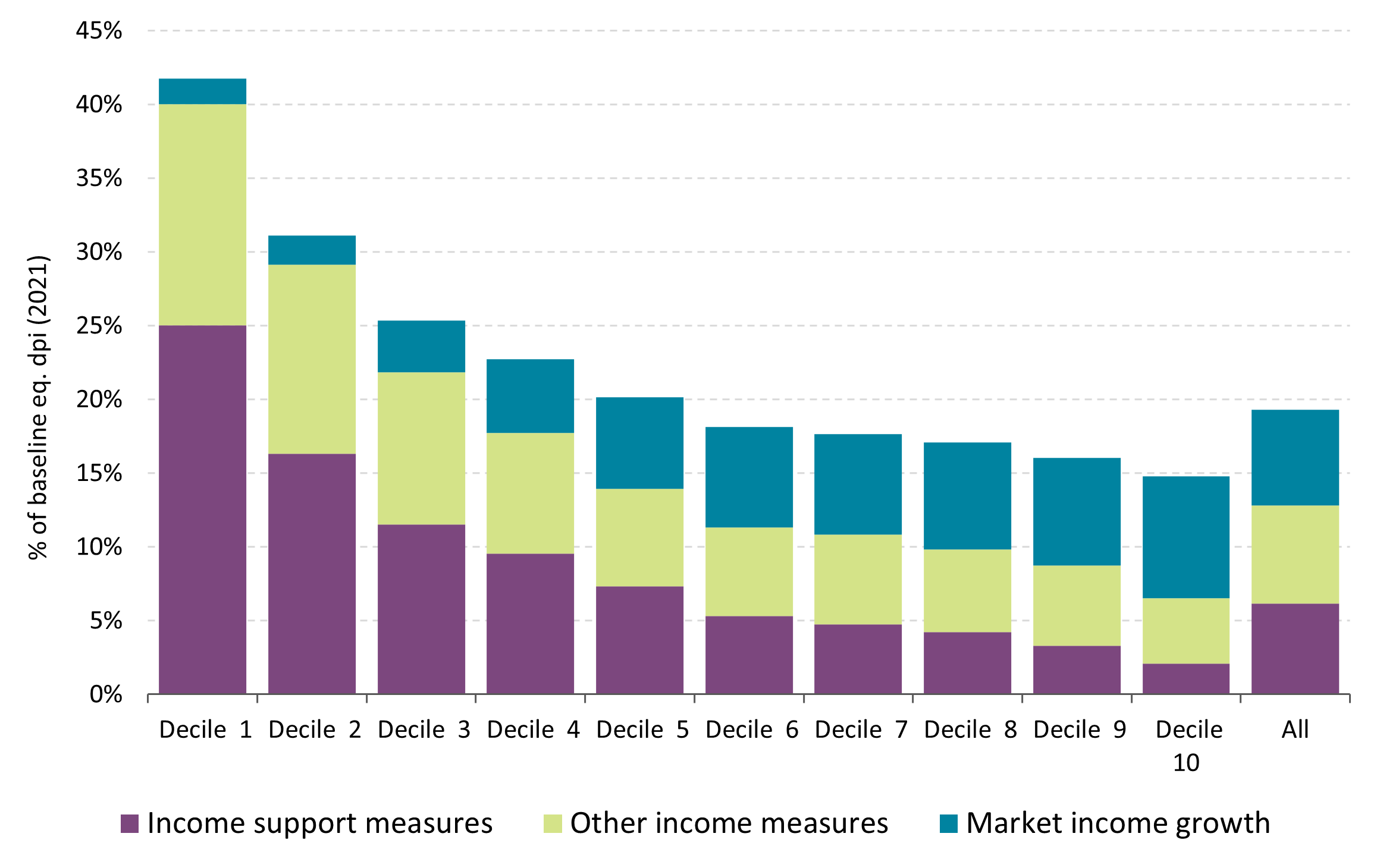
On a cumulative basis, the Government’s income (as compared to price) measures were the most important driver of income growth for half the distribution. They were particularly important for households with the lowest 10 per cent of incomes, increasing their nominal disposable income by 25 per cent between 2021 and 2024. This compares to 2 per cent for the top 10 per cent of incomes.
In contrast, the effect of universal VAT and excise cuts (price measures) was smaller and less progressive, with households across the income distribution benefiting to a similar extent. The simulation results suggest greater targeting of measures could have delivered fiscal savings, while still achieving the aim of shielding the most vulnerable.
Introduction
The inflation shock and fiscal response
Over 2022 and 2023, the price level of goods and services in Ireland surged. [1] The annual change in general prices, as measured by the Harmonised Index of Consumer Prices (HICP), peaked at 9.7 per cent in summer 2022. However, higher inflation had a larger initial, adverse impact on lower-income households who spend a higher share of their income on essentials such as energy and food (items with the largest and most volatile price changes).
In response, the Irish Government adopted a wide array of tax and expenditure measures to cushion the impact of the inflationary shock on households’ purchasing power. We estimate around 80 per cent of the measures were aimed at supporting incomes. These included targeted lump sum cash transfers to recipients of certain social welfare payments, as well as untargeted measures, such as energy credits that provided every household with a reduction in their energy bills. The remaining 20 per cent of the fiscal response comprised VAT and excise duty changes aimed at containing price rises.
These measures were initially introduced as temporary supports in 2022, but many were repeated over subsequent years. Over 2022 to 2024, the gross fiscal cost of the three-year package of household measures is estimated to have amounted to €10.6bn, equivalent to around 1.2 per cent of GNI* each year, with only one third of the cost-of-living supports introduced fully targeted (QB4, 2024 (PDF 3.3MB)). Against this backdrop, this Staff Insight examines the effect of the Government’s cost-of-living response across the income distribution.
Quantifying the impact of the inflationary shock and fiscal supports
We conduct a microsimulation exercise, which involves applying the tax-benefit microsimulation model for the European Union (EUROMOD) to household level data from the 2022 EU-Survey of Income & Living Conditions (where the income reference period is 2021) matched with the 2015 wave of the harmonized Household Budget Survey.[2]
For our microsimulation, we model most of the fiscal measures aimed at supporting households.[3] The impacts we identify are commonly referred to as immediate “morning-after” impacts because EUROMOD is a static simulator and therefore behavioural changes – such as households choosing to consume less or substitute away from certain goods and services in response to higher prices – are not incorporated. The analysis presented in this Staff Insight builds on research completed as part of a larger, cross-country project conducted by the ESCB Network on Microsimulation Modelling, and follows an earlier paper by Amores et al. (2024) exploring the compensatory role of income supports in 2022 for six euro area countries. Curci et al. (2025) also use microsimulation to provide a case study for Italy, finding similar results to those in this Staff Insight.
Microsimulation approach
Modelling inflation and the measures
Our microsimulation leverages two specific EUROMOD tools. First, we use the Consumption Tax Tool (CTT) to simulate the effect of inflation and the price measures. The CTT compares two 2024 scenarios to a pre-inflation 2021 baseline. This enables us to compare observed commodity prices (and the associated consumption tax liability) against a hypothetical scenario in which the same inflation occurred, but the Government did not implement price measures. For the simulation, we apply the CTT’s “constant quantities” assumption, meaning we assume that households buy the same quantities of goods and services. Amores et al. (2024) make the same assumption, justifying this on the basis that the 2022 energy crisis was unexpected; provoking a sudden surge in general prices that was mostly driven by increases in energy and food, which are difficult to substitute.
Second, we use the Policy Effects Tool (PET) to explore the impact of the Government’s income measures implemented over 2022 to 2024. This tool enables us to isolate the contribution of the Government’s income supports to disposable income growth from regular nominal increases in wages and salaries (what we term “market income growth” [4]) and other policy changes in the tax and benefit system (such as changes in social welfare payment rates, increases in tax credits and the broadening of tax and Universal Social Charge (USC) bands) that also contribute to disposable income growth. For further detail on the model and tools, see the Appendix.
Measuring the impact
We use two different measures to capture the effect of inflation on households, and in turn the role of fiscal supports in alleviating this effect:
- Real Disposable Income – adjusts nominal disposable income growth for the impact of inflation. By considering income growth in real terms, this measure provides insight into the extent to which the purchasing power of households’ incomes has been eroded, regardless of whether that income is consumed or saved.
- Cost-to-Maintain Consumption – measures how much extra money households would need to spend at the inflated prices, to obtain the same basket of goods and services in 2024 as in 2021. We present this additional expenditure as a share of 2021 equivalised disposable income. This second measure is insightful because it provides a joint evaluation of price and income changes, and accounts for differences across households both in terms of exposure to inflation and in the proportion of income spent. If actual income growth is less than the growth required to meet this additional expenditure, then households will need to use savings or other resources to consume the same consumption basket.
Finally, as we are interested in a distributional analysis, after running the EUROMOD tools and simulating our measures, we rank all households by their equivalised disposable income and divide this income distribution into 10 equally sized groups or deciles. Each of these deciles represents 10 per cent of incomes. In this way, we can more meaningfully and precisely present the distributional impact (see Boyd & McIndoe-Calder (2025) for more discussion on the benefits of this approach).
Impact on Disposable Income
Impact of income measures on decile-specific nominal incomes
The EUROMOD results indicate nominal disposable income grew by 19.3 per cent on average between 2021 and 2024, with each of three income sources making an equal contribution (Figure 1). However, there is considerable variation across the income distribution. For households in the bottom half of the distribution, the Government’s income support measures were the most important driver of income growth. The cost-of-living income measures were particularly important for the bottom 10 per cent of incomes, increasing their disposable income on average by 25 per cent between 2021 and 2024, compared to around 2 per cent for the highest 10 per cent of incomes.
Income measures supported nominal incomes progressively between 2021 and 2024
Figure 1: Distributional impacts on cumulative, equivalised nominal disposable income growth
Source: EUROMOD simulation and authors’ calculations
Note: The chart represents the components of cumulative nominal disposable income growth between 2021 and 2024 across the equivalised disposable income distribution. Growth is broken down into market income growth, policy effects (from the income support measures) and other income measures. The results are obtained by measuring the difference between equivalised disposable income inclusive of the fiscal measures and equivalised disposable income in a counterfactual scenario where the fiscal measures are reversed.
Accessibility: Get the data in accessible format. (CSV 18.94KB)
In contrast, an inverse pattern is observed for market income growth, with the contribution of market-driven growth in salaries, wages, and pensions equivalent to over 8 per cent, on average, for the top 10 per cent of incomes compared to less than 2 per cent for the bottom decile. Other income measures (which over the three years included increases in the maximum rate of core weekly social welfare payments, the broadening of the standard rate tax band and uplifts in tax credits) also benefited lower-income households relatively more strongly. For the bottom 10 per cent of incomes, these measures contributed 15 per cent, on average, to cumulative disposable income growth, compared to 4.4 per cent for the top decile. This is consistent with the progressive design of Ireland’s personal income tax system and the fact that the nominal value of these other measures represents a larger share of income at the lower end of the distribution (Boyd & McIndoe-Calder, 2025).
Impact of inflation and price measures on inflation across the distribution
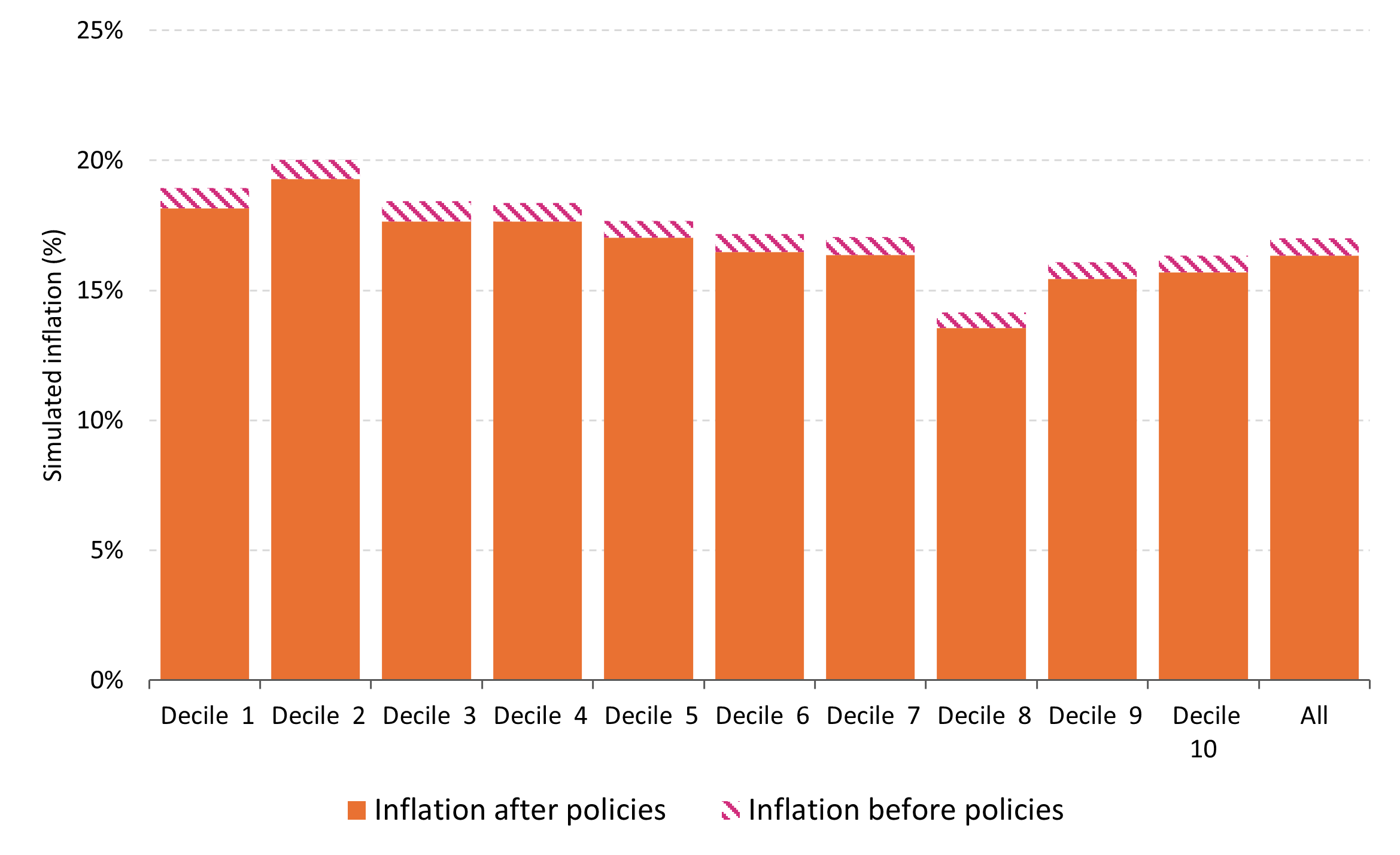
Considering next the impact of inflation and the price measures, the simulation finds that cumulative inflation between 2021 and 2024 amounted to 16.3 per cent on average. This compares to 15.2 per cent according to official Eurostat HICP data. Without the Government’s price measures, simulated inflation would have been around 17 per cent. This indicates that, assuming consumption quantity is maintained, the “morning after” policy effect of the price measures was to reduce the inflation rate, on average, by approximately 0.7 per cent (Figure 2). The policy effect varies little across the distribution, consistent with VAT and excise cuts being universal. For the first three decile groups, the price measures reduced the simulated cumulative inflation rate from 19.1 per cent on average over 2021 to 2024, to 18.4 per cent. The corresponding decline for the top 30 per cent of incomes was 15.5 per cent to 14.9 per cent.
Cuts in VAT and excise duty had a small but similar effect in limiting cumulative inflation for all decile groups
Figure 2: Change in effective inflation rate – by decile
Source: EUROMOD simulation and authors’ calculations
Note: Orange bars in this chart depict the simulated, decile-specific, cumulative inflation between 2021 and 2024 with price measures applied. The pink dashed bars represent the further increase in the inflation rate that would have occurred if price measures had not been implemented. They can therefore be interpreted as the policy effect.
Accessibility: Get the data in accessible format. (CSV 0.84KB)
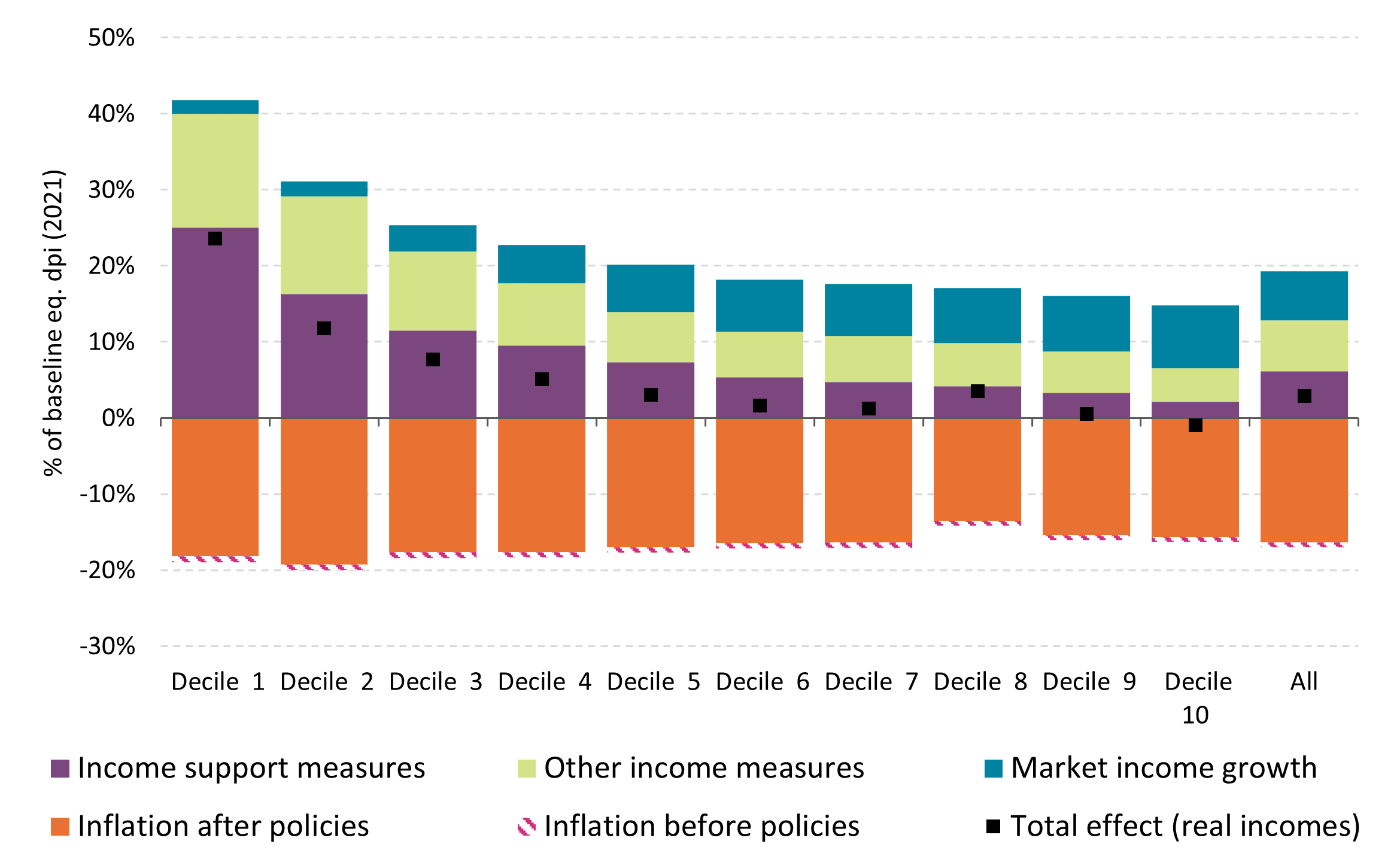
Combining the negative effect of inflation with the positive effect of the Government’s price and income measures, the estimated change in real disposable incomes follows a clear progressive pattern (black dots in Figure 3). The gain, in terms of purchasing power over 2021 to 2024, for the bottom 10 per cent of incomes was close to 24 per cent, whereas it was largely unchanged for the top 10 per cent (-0.9 per cent).
Real disposable income grew by more at lower income levels between 2021 and 2024
Figure 3: Distributional impacts on equivalised disposable income and consumer inflation
Source: EUROMOD simulation and authors’ calculations
Note: The chart represents the components of cumulative disposable income growth and the effects on consumer inflation over 2021-2024 across the equivalised disposable income distribution. Disposable income growth is broken down into market income; income supports and other income measures. The orange bars depict the simulated decile-specific, cumulative inflation between 2021 and 2024 with price measures applied. The pink dashed bars represent the further increase in the inflation rate that would have occurred if price measures had not been implemented. The results are obtained by measuring the difference between households’ disposable incomes and their inflation rates with the measures applied and the same in a counterfactual scenario where measures are not applied.
Accessibility: Get the data in accessible format. (CSV 1.59KB)
Impact on Consumption
Impact of fiscal supports from the perspective of cost-to-maintain consumption
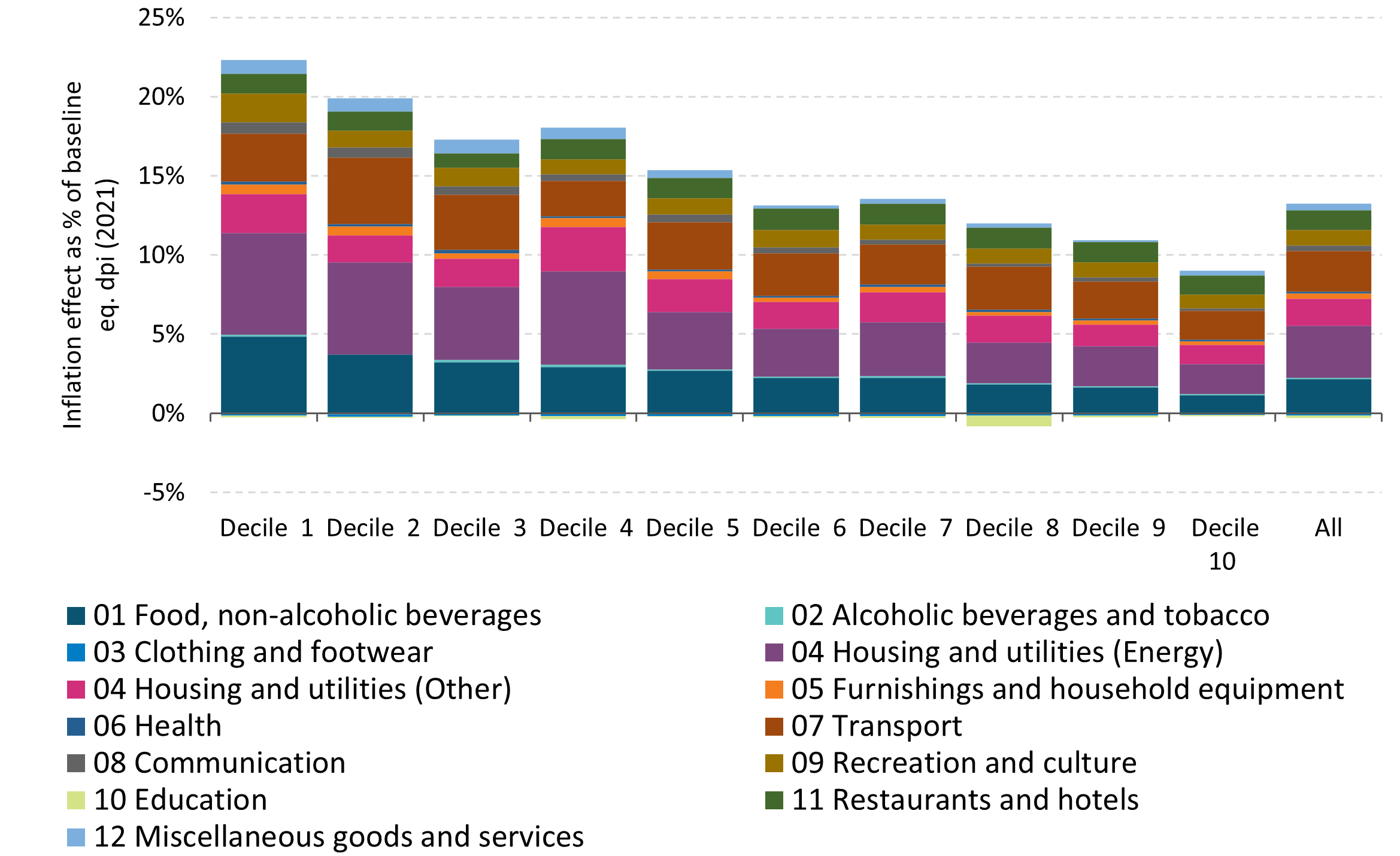
Applying our second measure, the average household would need to spend 13 per cent more of their baseline income to consume the same basket of goods and services in 2024 as in 2021 before the inflation spike (Figure 4). This required expenditure increase is driven primarily by price increases related to Energy, Food and Transport, with those on lower incomes spending a larger share of their income on these goods and services. This is consistent with previous work by Lydon (2022) (PDF 237.71KB) and Arrigoni, Boyd & McIndoe-Calder (2022) (PDF 676.87KB), showing lower-income households spend a larger share of their income on essentials. Lower-income households also have lower savings rates. For example, spending typically exceeds income, on average, for households in the bottom 20 per cent of the distribution, implying negative savings rates (Boyd, Byrne & McIndoe- Calder, 2025 (PDF 1.05MB)).
These differences mean the burden of the inflationary shock is not equal along the distribution. In our simulation, we estimate the bottom 10 per cent face additional expenditure equivalent to around 22 per cent of their 2021 disposable income to keep their consumption bundle constant, compared to approximately 9 per cent for the highest 10 per cent of incomes.
The inflationary shock disproportionately impacted lower income groups
Figure 4: Inflationary shock (burden, as % of baseline disposable income) per product and decile
Source: EUROMOD simulation and authors’ calculations
Note: The chart shows the inflationary shock – or burden – as a per cent of 2021 equivalised disposable income for each decile and each of the main COICOP categories, with Housing & Utilities split between Energy and Other. The values are charted as positive values, but the impact should be interpreted as negative.
Accessibility: Get the data in accessible format. (CSV 3.48KB)
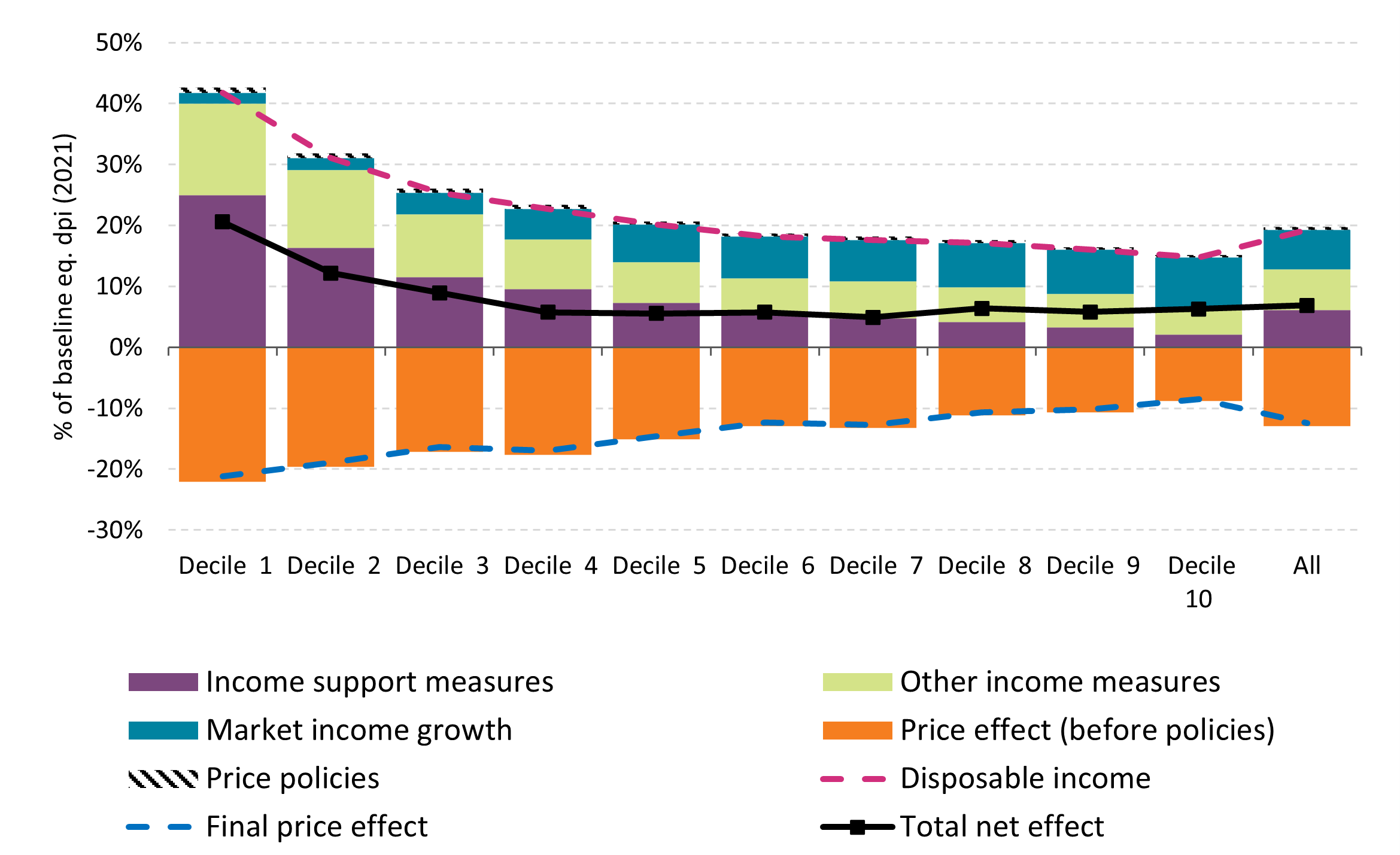
Positively, our simulation results show the fiscal measures implemented over 2022 to 2024 helped ensure the potential welfare loss (from being unable to meet additional expenditure induced by the inflationary shock) was fully mitigated for all households (black line in Figure 5). On average, we estimate households experienced a roughly 7 per cent welfare gain between 2021 and 2024, meaning households in our simulation received, on average, cumulative disposable income growth that enabled them to consume their pre-inflation basket at the inflated prices, with additional income left over.[5]
The progressive effect of income supports counteracted the regressive impact of inflation
Figure 5: Welfare effect across income deciles
Source: EUROMOD simulation and authors’ calculations
Note: This chart shows the impact of the inflationary shock on the decile-specific consumption basket, i.e. the increase in household expenditure between 2021 and 2024, as a share of 2021 equivalised disposable income. This share is charted as a negative impact (orange), before considering the compensating government policies on the price side (dashed black and white). Positive bars show the positive impact on household purchasing power from (i) market income growth (teal), (ii) cost-of-living income supports (purple) and (iii) other income measures (green). The net effect across the distribution (black dots and line series) is obtained by deducting the inflationary shock from the total positive impact of income growth and price measures.
Accessibility: Get the data in accessible format. (CSV 0.55KB)
Across the distribution, the net effect is progressive. In relative terms, the income measures had a positive effect on the lowest 10 per cent of incomes that was 12 times greater than the positive effect for households with the highest 10 per cent of incomes. The relative policy effect of the price measures, in contrast, was less than 3 times higher. This indicates that income measures played a far more important role in mitigating the potential welfare losses than VAT and excise cuts.
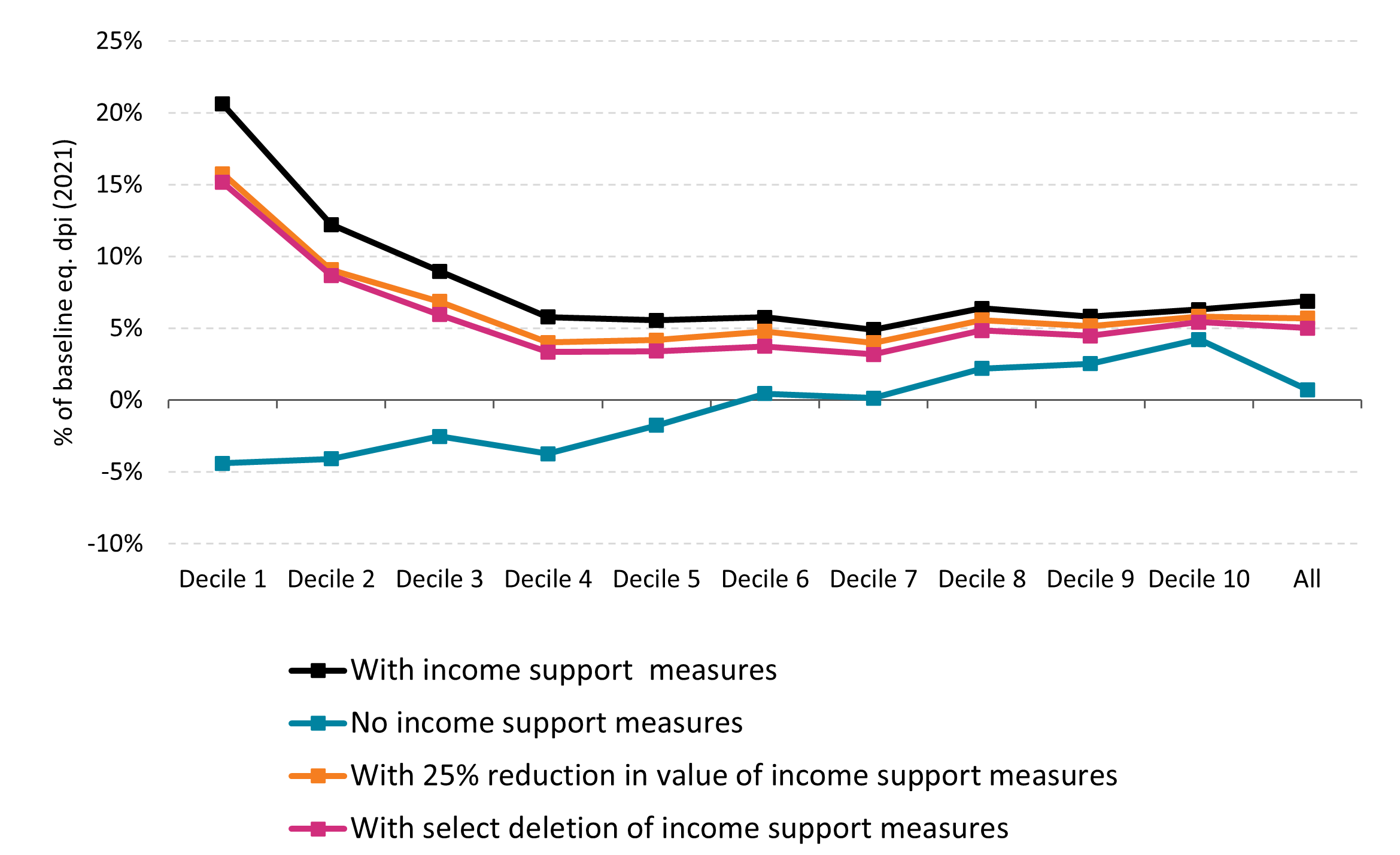
Without the income support measures, the welfare effect would be substantially reduced to only 0.7 per cent overall (teal line in Figure 6). Under this scenario, a clear regressive pattern would emerge with only households with the top 30 per cent of incomes receiving income growth above the level required to maintain their consumption at pre-inflation levels. To further explore the simulated welfare effect under alternative fiscal packages, we consider two additional counterfactuals.
In the first, we reduce the cumulative value of the lump sum cash transfers, energy credits, fuel allowance lump sums, rent tax credit and available mortgage interest relief by 25 per cent, while retaining the same market income growth rate and cumulative effect of other measures, and then re-run the simulation. We find that the net effect is reduced from approximately 7 per cent to around 6 per cent, but €1.4bn of estimated fiscal savings are achieved (orange line in Figure 6). More importantly, the lowest income households continue to be the most protected in our simulation.
Without the income supports, lower income households would have received insufficient income growth to maintain their consumption in 2024 at 2021 levels
Figure 6: Welfare effect across income deciles, by presence of income measures
Source: EUROMOD simulation and authors’ calculations
Note: This chart compares the baseline net effect of income supports, price measures, nominal income growth, other income measures after inflation, as shown in the previous Figure 5, across the income distribution against three counterfactual simulations which retain the same effects of inflation, price measures, nominal income growth and other measures but (i) remove all income support measures; (ii) reduce the cumulative value of lump sum cash transfers, energy credits, fuel allowance lump sums, rent tax credit and available mortgage interest relief by 25 per cent, and (iii) halves the available energy credits, provides only two extra monthly child benefit payments and omits mortgage interest relief from the original package of fiscal supports.
Accessibility: Get the data in accessible format. (CSV 0.53KB)
Similar outcomes are achieved in a second alternative simulation, which halves the available energy credits in the fiscal package, provides two extra monthly child benefit payments as opposed to four and omits mortgage interest relief which disproportionately benefited higher earners (pink line in Figure 6). Under this version of income supports, the estimated fiscal savings in the simulation rise to €2bn. These simulated illustrations of additional counterfactuals are not to be interpreted as policy advice or optimal policy. Rather, they are intended to demonstrate how different choices around the fiscal package, including greater targeting, could have potentially provided significant fiscal savings to the taxpayer, while continuing to support to the most vulnerable.
Scope for this is also demonstrated by exploring the composition of income supports across the distribution. We estimate the untargeted energy credit, rent credit, mortgage interest relief and child benefit accounted for around 85 per cent of the income supports received by households with the top 30 per cent of incomes, but closer to half for the bottom 30 per cent, where more targeted fuel allowance and social welfare lump sums were important.
Conclusion
In this Staff Insight, we report the results of a microsimulation exercise to explore the impact of the fiscal supports implemented by Government, over 2022 to 2024, in response to the 2022 inflation surge. We show that, in Ireland, the cost-of-living measures, complemented with growth in market incomes, helped offset the potential welfare loss. However, the fiscal cost of these largely untargeted supports, at around 1.2 per cent of GNI* per annum from 2022 to 2024, was substantial.
Our simulation indicates that income measures, such as lump sum cash transfers, were more effective in compensating for inflation than price measures. The estimated cumulative impact of the income support policies was to boost nominal disposable income, on average, by 6 per cent between 2021 and 2024. In contrast, price measures in the form of universal cuts in VAT and excise duty had a smaller effect, corresponding to reducing the cumulative inflation rate by an estimated 0.7 per cent. This smaller effect reflects differences in scale compared to the income measures, but also the extent to which the measures were targeted.
From a distribution perspective, the effect of the price measures varies little across the distribution whereas for those with the lowest incomes, the income measures were particularly important. Without them, this group would have received insufficient income growth to maintain their consumption at pre-inflation levels. In contrast, the results suggest that households with the top 30 per cent of incomes would have continued to maintain their consumption, with income leftover, even in their absence. The results emphasise the importance of accounting for differences in market incomes and saving patterns across households when designing policy supports and suggest stronger reliance on targeted income measures could have safeguarded the most vulnerable at a smaller fiscal cost.
References
Amores, A. F., Basso, H. S., Bischl, J. S., De Agostini, P., Poli, S. D., Dicarlo, E., ... & Riscado, S. (2024). Inflation, fiscal policy and inequality: The distributional impact of fiscal measures to compensate for consumer inflation. Banco de Espana Occasional Paper, No. 2418.
Arrigoni, S., Boyd, L., & McIndoe-Calder, T., (2022). Household economic resilience. Quarterly Bulletin Signed Article, QB4 2022. Central Bank of Ireland.
Boyd, L., Byrne, S., & McIndoe-Calder, T., (2025). The evolution of household savings: determinants and implications. Signed Article No. 1, Vol. 2025. Central Bank of Ireland.
Boyd, L. & McIndoe-Calder, T., (2025). Personal income and fiscal drag across the distribution. Staff Insight No. 4, Vol. 2025. Central Bank of Ireland.
Curci, N., Savegnago, M., Zevi, G., & Zizza, R. (2025). The redistributive effects of inflation: a microsimulation analysis for Italy. International Journal of Microsimulation; 18(3); 87-100. doi: 10.34196/ijm.00330.
Dreoni, I., Serruys, H., Manso, L., Tudó-Ramírez, J., & Amores, A. F. (2025). Statistical imputation and validation of consumption microdata for EUROMOD (No. 2/2025). JRC Working Papers on Taxation and Structural Reforms.
Figari F. and Sutherland, H. (2013). EUROMOD: the European Union tax-benefit microsimulation model. International Journal of Microsimulation 6(1), 4–26.
Lydon, R., (2022). Household characteristics, Irish inflation and the cost-of-living. Economic Letter, No.1, Vol. 2022. Central Bank of Ireland.
Paulus, A., & Tasseva, I. V. (2020). Europe through the crisis: Discretionary policy changes and automatic stabilizers. Oxford Bulletin of Economics and Statistics, 82(4), 864-888.
Simon, A., Sándorová, S., Duggan, L., Doorley, K., & Keane, C. (2025). EUROMOD Country Report-Ireland. Publications Office, Luxembourg, 2025, JRC141182.
Appendix: The EUROMOD Model
What is EUROMOD?
EUROMOD is a static, non-behavioural microsimulation model developed for the EU-27 and managed by the European Commission’s Joint Research Centre. The model works by applying a set of rules to simulate taxes and benefits and ultimately calculate disposable income. For Ireland, these rules are provided by the ESRI. However, any user can subsequently change, remove or add rules. This means EUROMOD can estimate, for each individual, the amount of tax payable under different counterfactual scenarios. For more information about EUROMOD, see Figari & Sutherland (2013) and for the specific set-up for Ireland, see Simon et al., (2025).
Aggregating the derived individual liabilities, the total tax liability for all taxpayers can be estimated and explored using different population breakdowns. This includes by deciles of the equivalised income distribution, which this Staff Insight uses.
What EUROMOD tools do we specifically use in this analysis?
To model inflation and the impact of price measures, we use EUROMOD’s Consumption Tax Tool (CTT). The CTT works by applying consumption taxation rules, mapped to prices for around 200 commodity categories, to simulate adjusted household disposable income based on the shares of each commodity in a household’s consumption basket. The latter information comes from the 2015 HBS which has been matched to the 2022 EU-SILC input data (Dreoni et al., 2025). In our simulation, we apply the CTT’s constant quantities behavioural assumption (Paulus & Tasseva, 2020).
To model the income measures, we leverage EUROMOD’s Policy Effects Tool (PET), which estimates the first-order effects of policies on household incomes, allowing us to disentangle the policy effects from nominal income growth. More specifically, to isolate the policy effect of cost-of-living supports from other changes in the tax and benefit system, household disposable incomes under the actual system and a counterfactual system are assessed, keeping household characteristics and market incomes constant. Then, by comparing the output of the PET analysis with how total disposable income changed between 2021 and 2024, we can clearly identify and quantify the role of market income growth, income supports and other tax and benefit changes. For further detail on the PET and CTT tools, see Amores et al. (2024).
What fiscal measures do we model?
We model the reduction in VAT on electricity and gas and the reduction in excise duty on petrol and diesel, as well as the rent tax credit, mortgage interest relief, energy credits, fuel allowance lump sum payments, extra weekly social welfare payments, lump sum cash transfers to welfare recipients and child benefit double payments. Measures which could not be modelled in EUROMOD include: transport-related measures (such as the reduction in public transport fares and reduced caps on school transport fees); measures targeted at students (such as reductions in the student contribution fee, double payment for those eligible for SUSI maintenance and the student assistance fund) as well as reductions in the drug payment threshold and the public service obligation, and the extension of the Ukraine Emergency Support Scheme. We also do not model fiscal measures directed towards businesses. It should be noted that EUROMOD assumes full take-up of most social welfare payments and tax benefits, including the fiscal measures. The model also assumes full pass-through of VAT and excise cuts to consumer prices.
Endnotes
- Authors are economists in the Irish Economic Analysis division. Corresponding author: Laura Boyd, ieadmin@centralbank.ie. We would like to thank Maria Flevotomou (Bank of Greece and ESCB MSN) and Paula De Agostini from the JRC and ESCB MSN for technical support as well as Thomas Conefrey, Dave Cronin, Martin O’Brien and Fergal McCann for helpful comments. Views here are not necessarily those of the Central Bank of Ireland nor the ESCB. Remaining errors are our own. ↑
- At the time of drafting, consolidated EU-SILC and HBS microdata was not yet available for the latest HBS 2022/23 wave. However, comparing the expenditure shares in the two HBS waves show an overall, consistent picture with spending shares remaining broadly stable. Relative differences in the shares, across the distribution, are mostly within the range of 0-1 percentage points. The largest gap is in relation to spending on Fuel & Light, where the share for all households is 2 percentage points higher in 2022/23 than 2015, with a slightly higher 3 percentage point gap identified for the bottom 25 per cent of households. Nevertheless, changes in spending between 2015 and 2024 (the endpoint of our analysis) could impact the results and may also explain the gap between the simulated and official measures of inflation. ↑
- We estimate there was an additional €1.5bn of other household income measures that we could not model. See the Appendix for more detail. ↑
- It should be noted that the composition and characteristics of taxpayers in our 2024 simulation will still reflect the composition and characteristics of our 2022 EU-SILC sample. This means that income growth related to the expansion in employment over the period is not captured. ↑
- Any income leftover could be saved or spent. EUROMOD does not make any assumptions around this residual component of the analysis. ↑