What the (latest) Middle East conflict means for inflation, growth, and monetary policy in Europe
20 March 2026
Blog
 When the Governing Council met this week in Frankfurt, the backdrop was markedly different from the one we faced just six weeks ago.
In February, our central challenge was to gauge the two-sided risks to inflation and growth. Despite these risks I expected inflation to move within a narrow range around our 2 per cent target through 2026-27.
Today, and notwithstanding longer-term inflation expectations remaining anchored, we now confront a new and serious source of uncertainty: the conflict in Iran and the broader escalation of tensions across the Middle East. These external forces may have made the path ahead less clear but our commitment to achieving our target has not changed and nor is it contingent on the geopolitical environment. Indeed, history has taught us that it is precisely in such moments of elevated uncertainty that a clear anchor for inflation expectations matters most.
What has changed
The conflict changes both the supply and the demand-drivers of inflation and growth.
On the supply side, it quickly pushes energy prices higher, raising the risk that headline inflation moves back above target faster and more forcefully than we had expected. Sectors where energy is a significant input – such as fertilisers in food production – are also likely to experience a bout of cost-push inflation, that is where producers are under pressure to raise output prices because their input prices have increased.
The conflict also impacts the demand side, through its effects on real incomes, investment, confidence, financial conditions, and global trade. This is a slower-moving dynamic than the initial energy price shock, and creates a headwind to growth that could, over time, pull inflation down. While we cannot at this stage be precise about the scale of the impact, the March projections published yesterday illustrate the wide uncertainty band around the size and persistence of this energy shock, and how it could filter through to inflation and growth.
The December projections had oil and gas commodity prices falling through 2026 (-10 per cent and -19 per cent, respectively), before remaining broadly flat thereafter. The new March baseline projection is now for increases of 18 per cent (oil) and 28 per cent (gas) in 2026, before gradually falling back in 2027.
But there is much uncertainty around this outlook. Therefore, the Governing Council’s deliberations also considered adverse and severe scenarios where energy commodity prices could essentially peak at double or triple end-2025 levels. These scenarios – one of the lessons from the previous inflation episode which we adopted in our refreshed strategy – are informed by historic price distributions, including around the start of the Ukraine war.
Because energy consumption accounts for just under 10 per cent of the average household’s consumption basket, the initial direct pass-through to headline inflation is smaller than these scenarios suggest. We can also expect to see indirect effects – where increased input costs for goods and services as a result of higher energy prices shows up in cost-push inflation – and second-round effects – as nominal wages gradually adjust to the new price level. The charts at the end of the blog show the paths for inflation (headline and core) and real GDP growth under the various scenarios.
Monetary policy decision
Given upward and downward price pressures, and the different time-horizons over how these effects can evolve, combined with significant uncertainty around how things might develop, the case for waiting until we can be more certain about the outlook is strong.
It’s why we left the main policy rate unchanged at yesterday’s meeting. There will be time to re-assess at our next meeting (in six weeks). We are not pre-committing to a particular rate path.
Of course, this is the second energy supply shock we have faced within the space of five years.
We saw after the Russian invasion of Ukraine how sharp increases in energy prices – especially gas prices – squeeze producers and consumers, and how the staggered adjustment of wages can prolong wider adjustment, leading to extended bouts of above-target inflation.
The goal of monetary policy in such situations is not to prevent the energy shock from having any impact on prices at all (that would require such a painful adjustment of interests rates that the cost in terms of higher unemployment and lower incomes would make the cure far worse the disease) but instead to ensure that the change is a one-off adjustment in living costs, and that we avoid potential second effects whereby the adjustment to one shock becomes embedded in future price and wage setting, thereby contributing to persistent inflation above our 2 per cent target.
There are important differences today compared to where we were in 2022 that means the indirect and second round effects of this energy price shock might differ this time.
In early 2022, inflation was above 5 per cent even before the start of Russia’s invasion, reflecting supply bottlenecks and pent-up demand emerging from the pandemic. In contrast, last month’s headline inflation was 1.9 per cent.
The labour market was also in a different place four years ago, with historically high levels of job openings reflecting strong labour demand. This is not the case today, with job openings now close to pre-pandemic levels (2019) in most countries.
Finally, monetary policy was exceptionally accommodative up until June 2022, with a policy rate of minus 0.5 per cent. In contrast, the current rate of 2 per cent is within the range of our estimates for the neutral rate of interest, that is, where monetary policy is neither restrictive nor accommodative. Inflation expectations are also anchored at our 2 per cent target.
But we must also be wary of complacency. After several years of above-target inflation it could be that households, businesses and financial markets are more sensitive to new shocks. We therefore need to be alert to the risk of inflation expectations becoming disanchored more quickly than before. In addition to inflation expectations – for consumers, firms, and markets – I will be closely monitoring a range of indicators to gauge the indirect and second round effects of this shock, including producer and consumer prices (not just changes in averages but the frequency and breadth of price changes across the basket), core inflation components (notably services and other domestic sources of inflation), wage trackers (including both the Indeed Wage Tracker developed with colleagues at the Central Bank and the ECB’s Negotiated Wage Tracker) and the evolution of firms’ profit margins.
Conclusion
As things stand today, risks to inflation have clearly moved to the upside, especially in the near-term, whereas risks to growth have moved to the downside. Inflation affects everyone (lower income households are most exposed to price movements because a greater proportion of their spending tends to be on energy-related goods and services) and, although monetary policy cannot prevent the energy shock from having an impact on prices, it can ensure that any change is a one-off adjustment in living costs. We are determined to deliver our 2 per cent medium-term target.
We will be publishing our own projections for the Irish economy next week.
Gabriel Makhlouf
Chart 1 | Euro area headline and core inflation (panels A and B) and growth (panel C) in the baseline, and under adverse and severe energy commodity price scenarios -headline-inflation.png?sfvrsn=3c8c721a_3 "(A) Headline Inflation %")
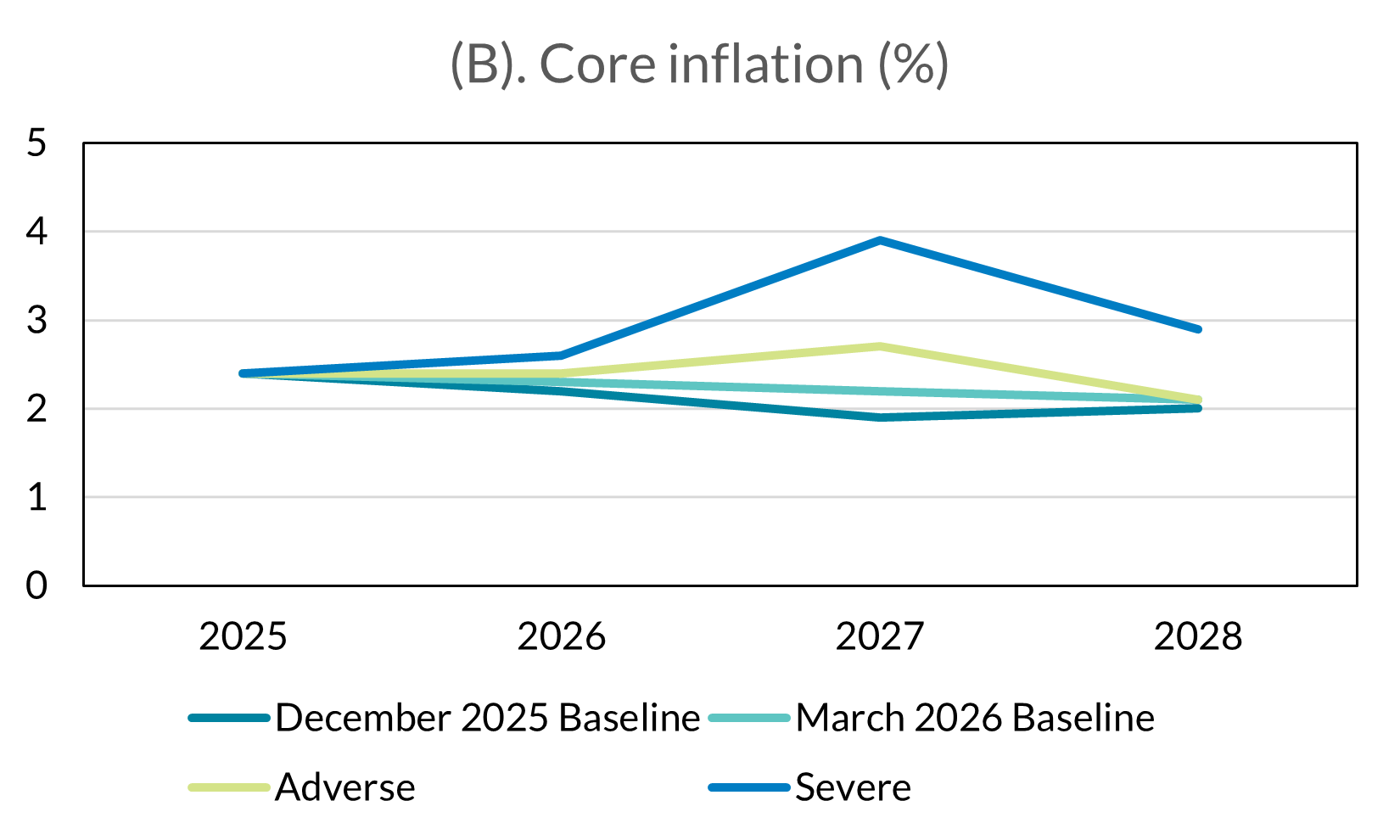
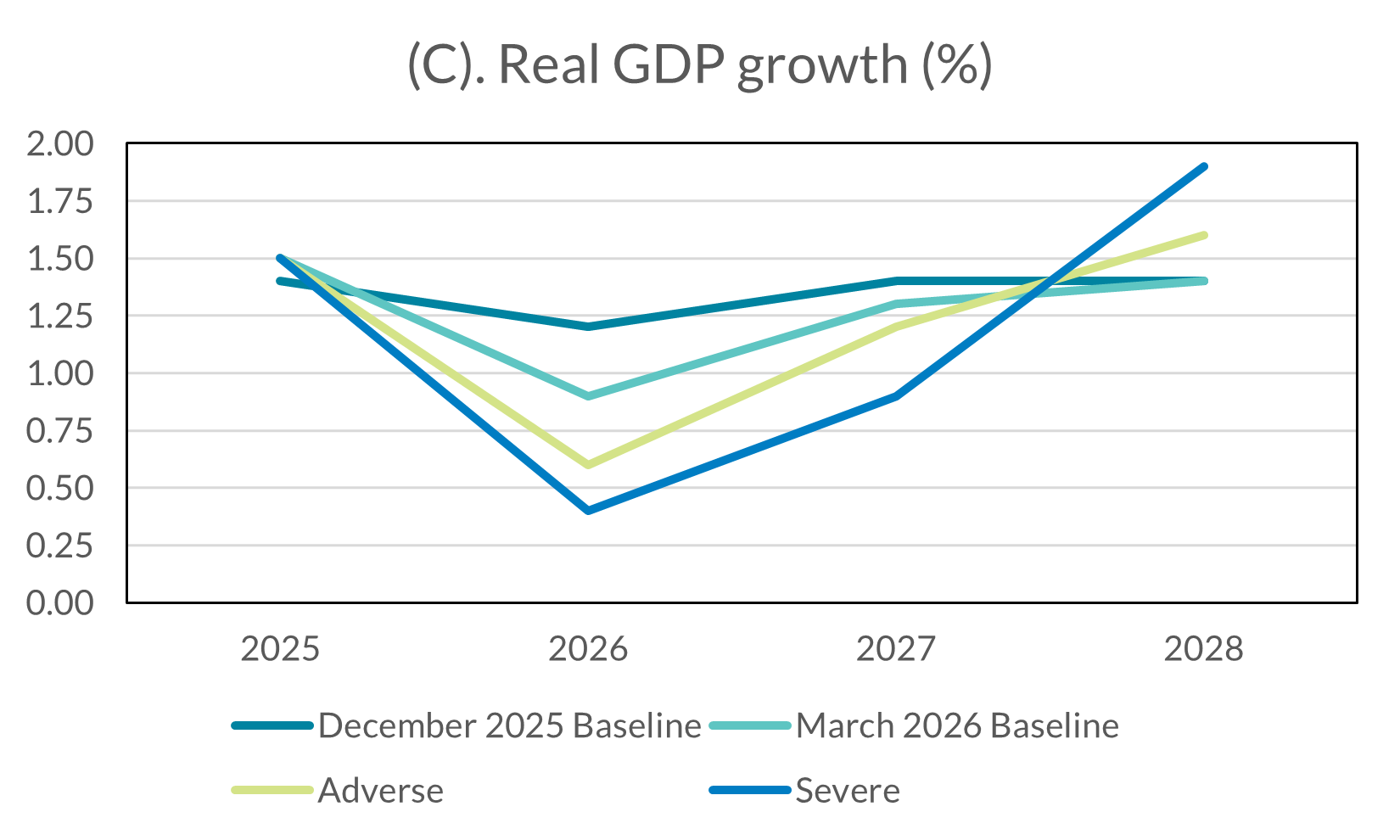
Source: ECB staff macroeconomic projections for the euro area, March 2026. Core inflation excludes energy and food prices. The March baseline scenarios include euro area interest rate path assumptions up to the cut-off date of 11 March 2026 as follows: “Market expectations for short-term interest rates have been revised up by 0.3 percentage points for 2026, by 0.5 percentage points for 2027 and by 0.3 percentage points for 2028, while long-term rates have been revised up by 0.1 percentage points throughout the projection horizon.” The adverse and severe scenarios make no additional changes to this rate path.